The Future of AI-Powered Creative Collaboration
 Koha Team•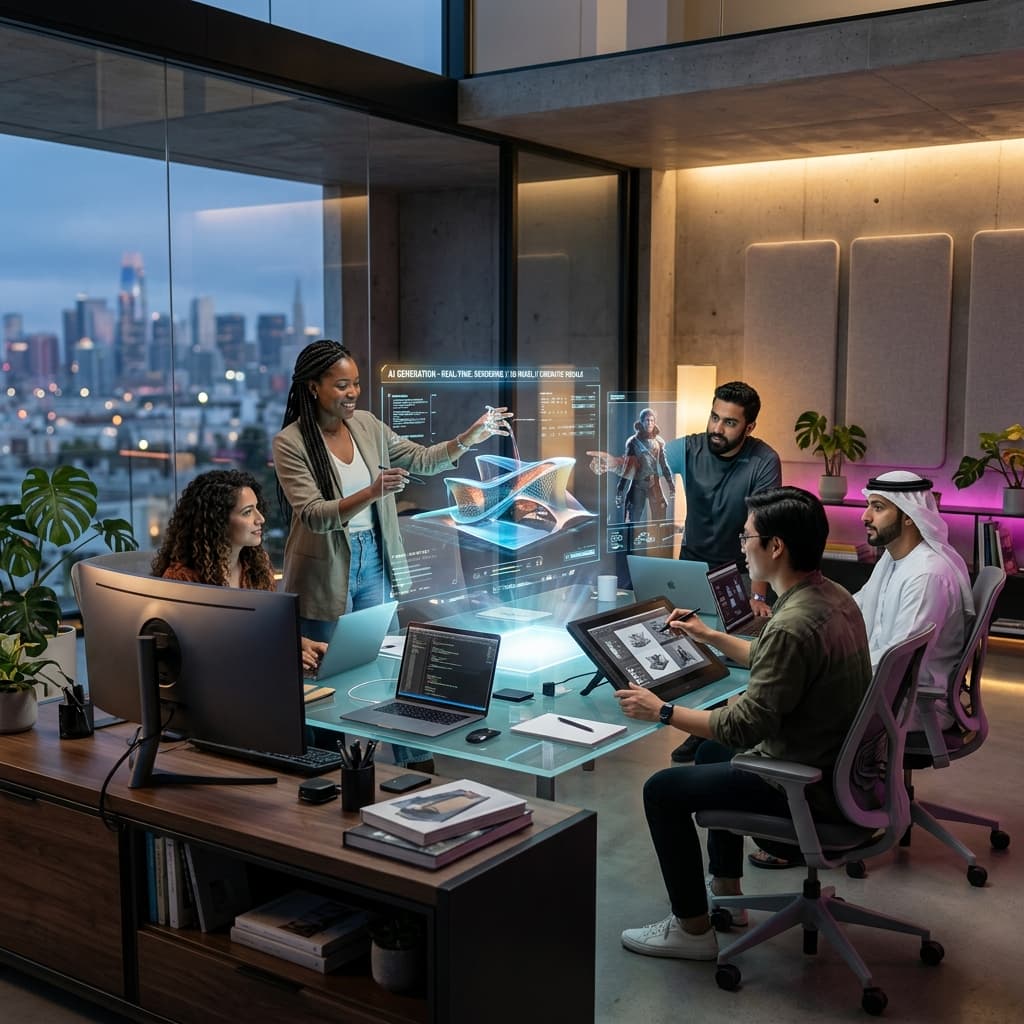
For years, creative work has been shaped by a simple but costly ritual: the handoff. One person creates, another reviews, someone else approves. Files move from inboxes to drives to chat threads, and somewhere between the third Figma export and the fourteenth Slack message, the original idea quietly loses its shape.
What looked like collaboration was often just coordination.
That model is breaking down, and not because teams want it to. It is breaking down because AI has changed the unit of creative work itself. The atomic step is no longer "make a deliverable and send it." It is "explore an idea together, in real time, with the asset live in front of you."
The End of Waiting Between Steps
Traditional workflows break energy into stages. A concept is designed in one tool, exported, uploaded to another, shared in a third, then sent back with feedback hours or days later. By the time revisions begin, the original spark has gone cold and half the context has been lost in translation.
Here is what that same loop looks like inside Koha:
A marketer drops a pin on the second frame of a campaign mock and writes, "can we try this with a softer palette and a winter mood?" The designer does not export anything. They do not open a separate tool. The AI regenerates that frame in place, against the brand library the team has been building all quarter. The product lead, watching live, reacts in the same canvas. Three rounds of iteration happen in fifteen minutes, doing what used to take two days of email threads.
The work, the feedback, and the decision all live in one place. Creativity stops being a queue and starts behaving like a conversation.
From Individual Talent to Shared Momentum
Most of the AI conversation has focused on the individual: better prompts, faster drafts, more personal output. That framing misses what is actually shifting.
The real change is collective.
When a founder, a designer, and a marketer are all looking at the same generative canvas, they no longer need to translate intent through static mockups or technical jargon. The non-designer can describe a direction in plain language and see it rendered. The designer can shape that output with craft the AI cannot replicate alone. The decision maker can react to something real instead of imagining it from a brief.
That collapses the loop between vision and execution, and quietly redistributes who gets to participate in shaping the work.
Why the Workspace Matters More Than the Model
Any model can generate an image. Many can write copy or produce video. The output layer is becoming a commodity faster than most people expected.
What is not a commodity is context.
Enterprise creativity does not live in a single prompt. It lives in the accumulation of decisions: the brand voice you spent two years sharpening, the colour system three designers argued over, the reference campaign that performed twice as well as the others, the feedback trail explaining why version four beat version seven. A model that does not know any of this is just a very fast intern.
The platforms that will matter are the ones that hold this context (brand library, version history, feedback trails, reusable assets, approval logic) and feed it back into every new generation. That is the difference between a tool that produces and a workspace where creativity compounds.
One Vision, Many Contributors
The honest version of the AI shift is not that it replaces creative people. It is that it removes the friction that used to sit between them: the exports, the version mismatches, the translation tax between roles, the days lost to scheduling a review.
When that friction disappears, something subtle happens to a team: people who were previously downstream of the creative process get pulled upstream. The marketer is in the room when the concept is being shaped, not three weeks later when it is too expensive to change. The founder can prototype an idea on a Sunday and have it stress-tested by Monday morning.
The future of work is not humans versus AI. It is not even humans with AI.
It is teams that have stopped handing work off to each other, and started building it together, in the same room, at a speed that used to feel impossible.